

February in the Falklands – restoration stone masonry
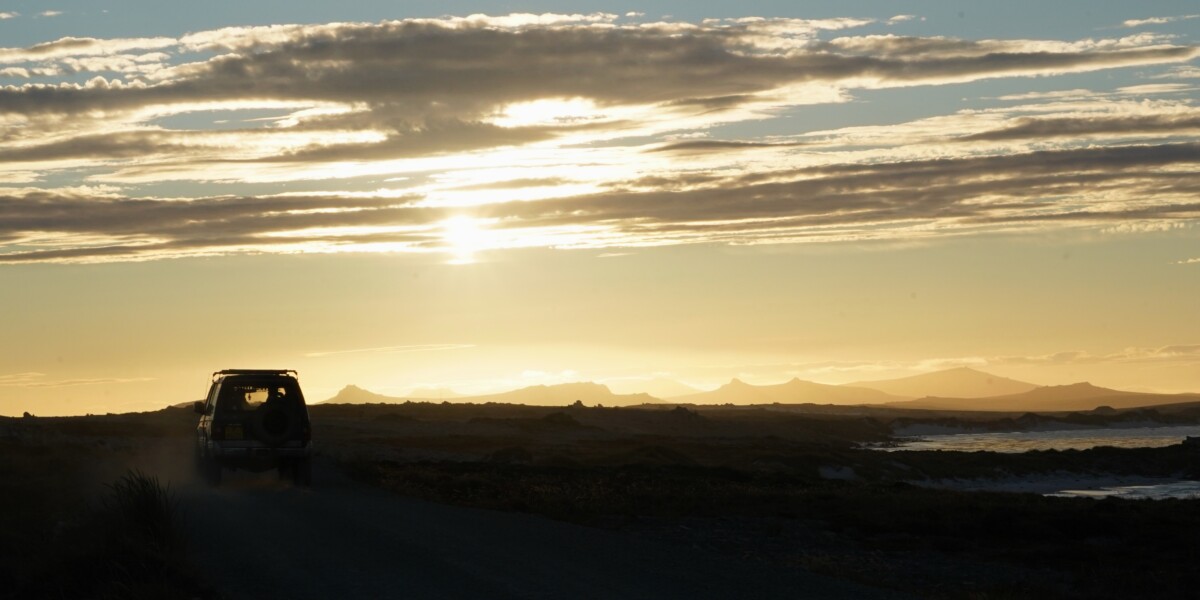
Stonemasonry on the Falklands
Ken Curran and I have just returned from the Falkland Islands after spending the month of February 2026 working on a stone masonry project for the Falkland Islands Museum and National Trust (FIMNT).
I had been in discussion with FIMNT for a couple of years about coming over to do some stonework for them. This was after I’d read on Facebook in early 2024 about Neil Read and John Shutler, two dry stone wallers from Dorset, who had worked repairing one of the dry stone corrals on the FIs. I got in touch with Andrea, the then manager of FIMNT. Discussions and plans over the next 18 months went from a maybe to a definite .
Ideally it would have been working on restoring one of the several dry stone corrals. However, they were looking for stone masonry skills to undertake restoration of several old stone buildings on various locations.
I have done some lime mortar work but it’s definitely not my area of expertise. Ken Curran of Earthstone in Ireland most defintely is.
With Emma Goss now managing the project and James Coles assisting her, Ken and I were booked to fly out on 1 February. We took the South Atlantic Airbridge from RAF Brize Norton on the via Ascension Island to Mount Pleasant Airport, Falklands.
The work plan
FIMNT produced an itinerary that would take us to West Point and Keppel Islands (both off West Falkland) and North Arm and Stanley on East Falkland. So two islands and two mainland projects.
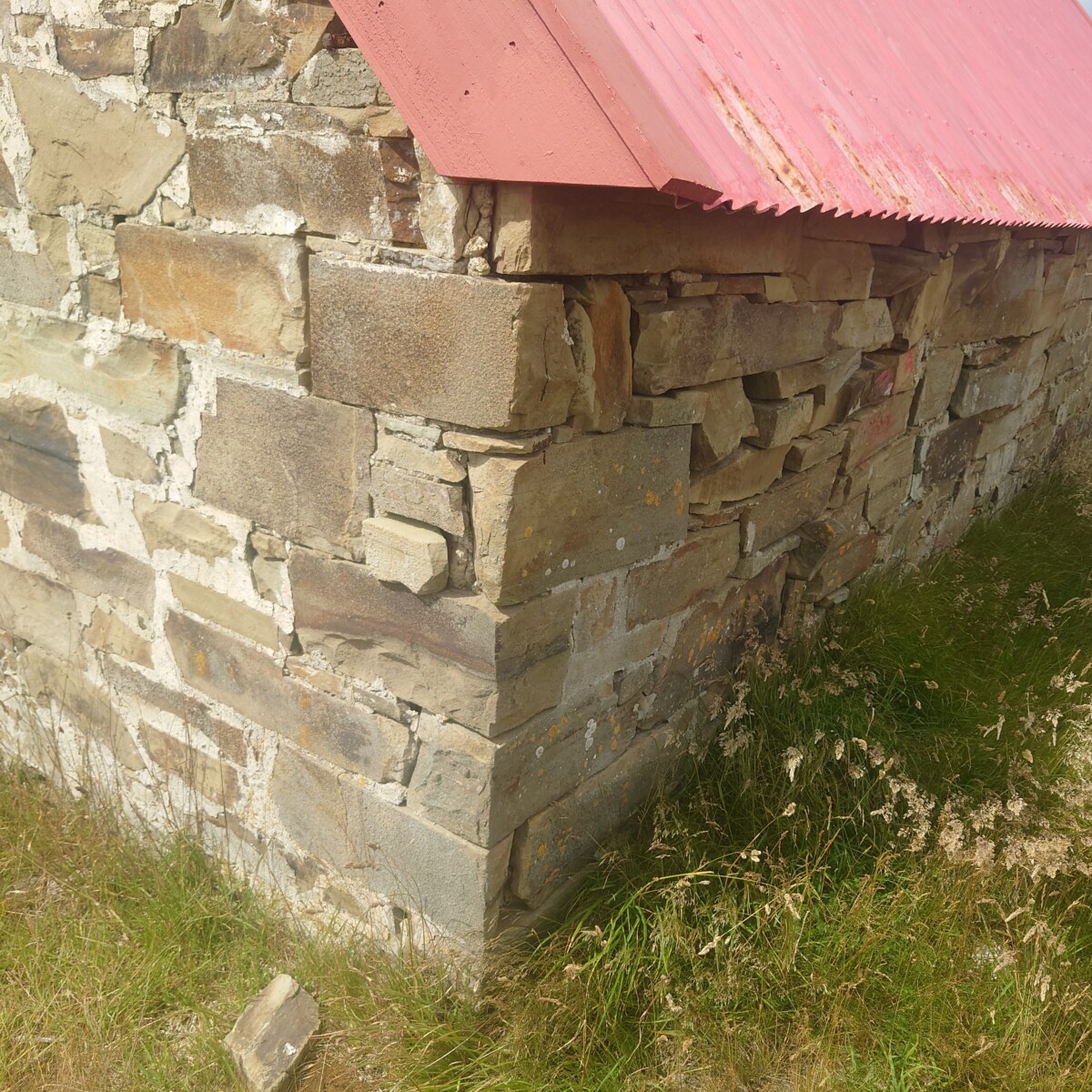
West Point has the Sealers Hut – reputed to be one of the oldest stone buildings on the islands – that required a rebuild of one gable end. Keppel had several possible buildings in need of TLC. North Arm had the chapel that needed a repoint and a rebuild of a partial collapse. And in Stanley there was the Stables that needed a repoint and a couple of sections taken down and rebuilt.
Quite a programme for four weeks!
As it turns out, the Falklands weather was the deciding factor on where we went and when.
The first week was planned to be a tour of Stanley, and a visit to the Stables on the Monday. On Tuesday we’d meet with the stakeholders of the West Point, North Arm and Keppel projects; and on the Wednesday Ken and I would fly to West Point, where we’d spend a week before getting over to Keppel.
All good, except the forecast wind cancelled the planned flight on the Islander aircraft used by the Falklands Island Government Air Service. So with a rescheduled flight for Thursday, Ken and I were driven the two and a bit hours south to North Arm Settlement where we took a look at the chapel and some other buildings there, as well as the dry stone corral at Darwin. And there was a bit of time for sightseeing at Goose Green.
On Thursday the flight was cancelled with an hours notice. This was the first sign that making specific plans on the Falklands can be a challenge. Instead with a couple of days to kill and a hire car provided by FIMNT we did some touristy things.
The 1982 War
I was 12 years old when the Argentines invaded the Falkland Islands on 2 April 1982. I watched the news with great interest every day until the islands were retaken on 14 June. Since then I’ve read numerous books on the subject. It’s been a place I’ve wanted to visit for a very long time.
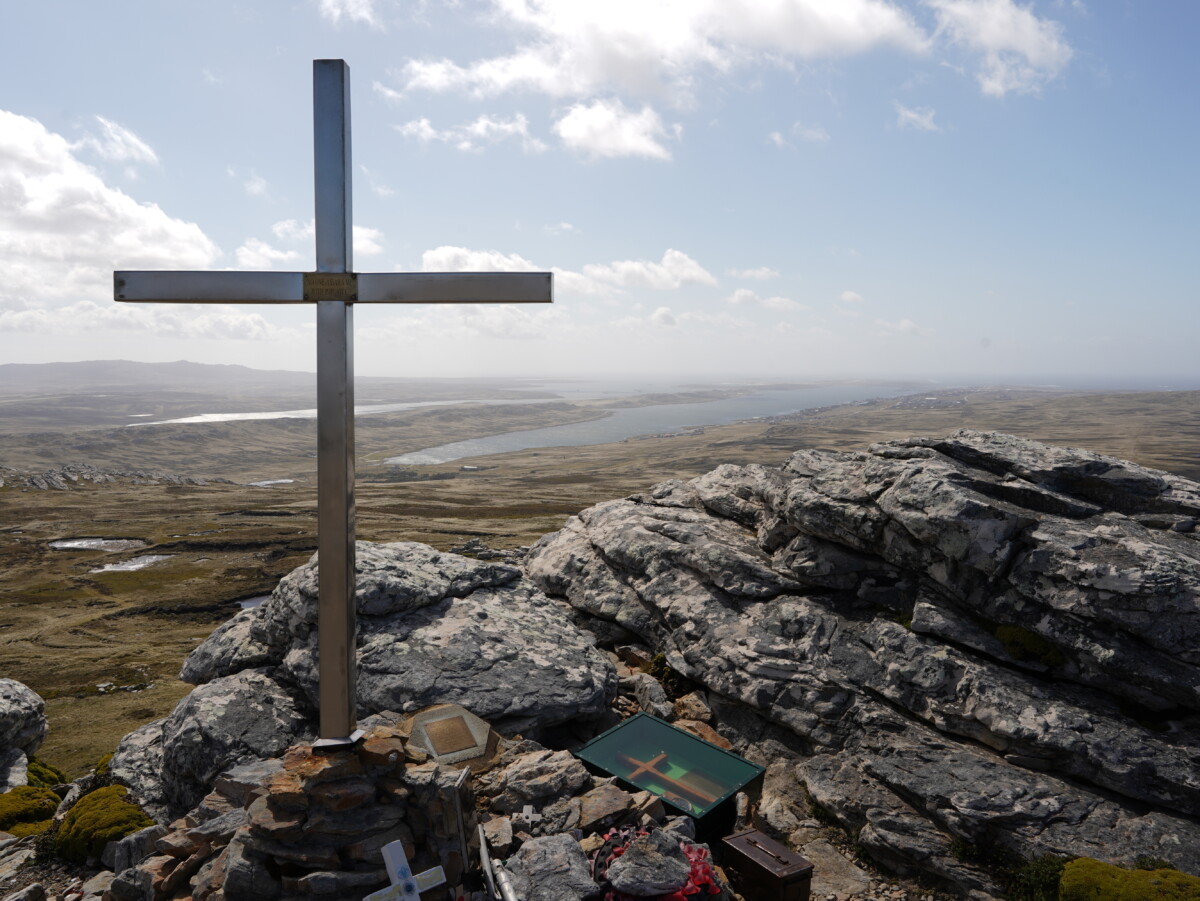
So when I found I had the opportunity to work there, it was important for me to visit some of the war sites. The picture above is from the top of Tumbledown, where the Scots Guards took the hill on the night of 13 June with 10 British and 30 Argentine soldiers killed. Ken and I walked up to the summit memorial on a glorious morning to take photos of the cross, looking down toward Stanley, a few short miles away.
In the course of the trip we also visited the 2 Para memorial and the Argentine cemetary at Darwin; Nick Taylor’s grave at Goose Green and the British cemetary at San Carlos.
The Falklands War had a huge impact on the islands and having taken place only 44 years ago, it lives long in the memories of locals. Indeed, everyone you talk to over the age of 50 remembers it well.
The cemetaries and memorials are a very sobering reminder of the blood shed by young men of both nations.
Getting on to Keppel Island
Finally on the Sunday 8th February, Shane Blackley the owner of Keppel Island took us on a journey to his island.

And what a journey it was!
It wasn’t quite planes, trains and automobiles, but not far off it!
There is only one section of tarmac road on the islands -the 33 miles from Stanley to Mount Pleasant.
The rest of the roads are a mix of hard packed gravel roads and dirt tracks. 4×4 vehicles are a must. The roads are fine, care is needed. As well as the gravel roads there are the FIGAS Islander passenger aircraft that fly between Stanley and the many grass airstrips dotted around the settlements and remote islands. And there is a small ferry between East and West Falklands.
Ken and I, driven by Shane, were headed to Keppel.
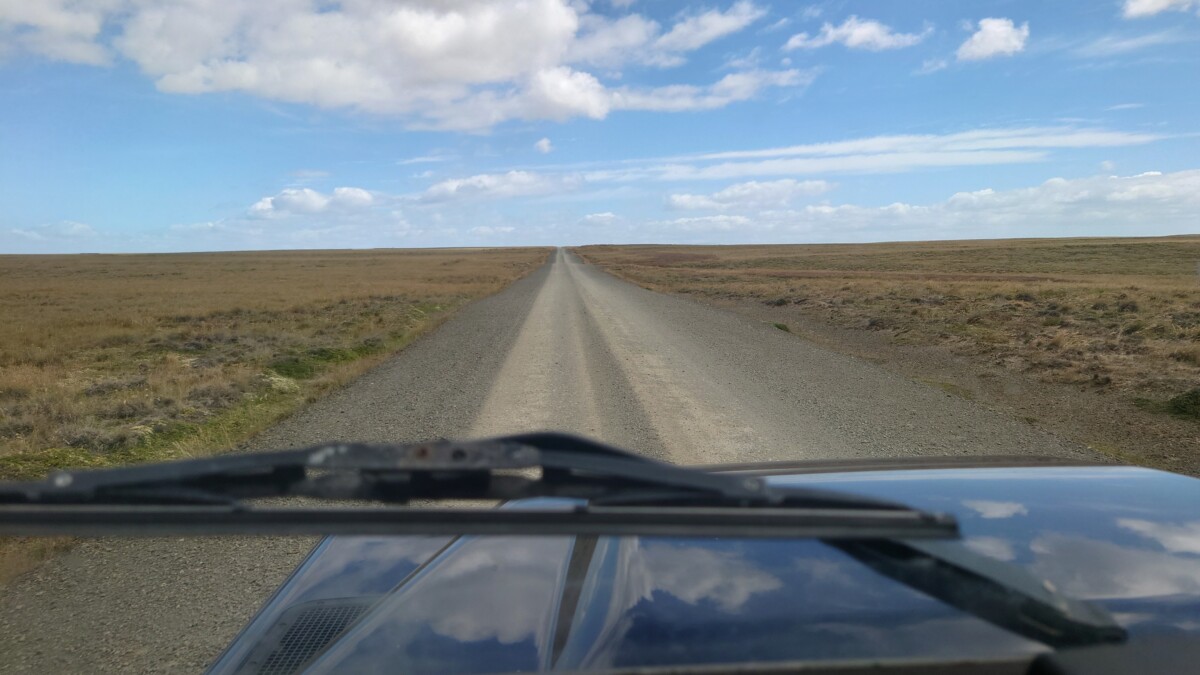
After packing his Landrover with a tonne of stuff, food and refreshments, we drove the tarmac road to Mount Pleasant Airbase and then the gravel track to New Haven for the ferry.
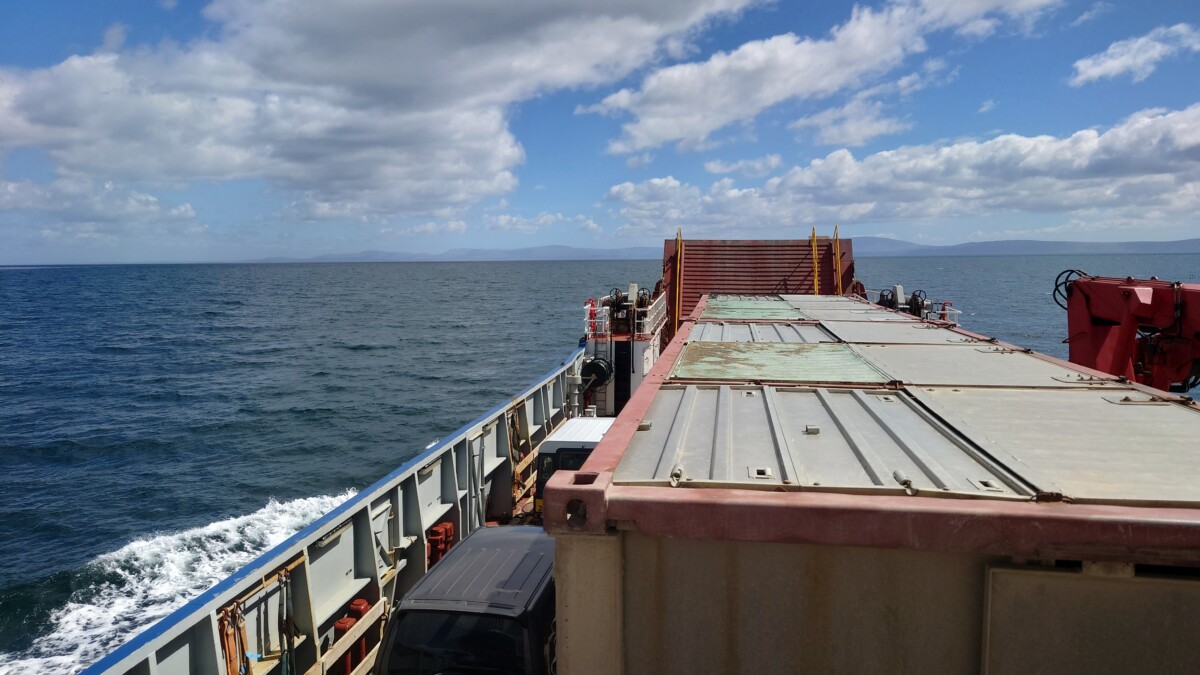
A two hour crossing took us from East to West Falkland. Back in the Landrover, 2 more hours of gravel roads and then a few miles of off-road driving took us to a rocky beach.
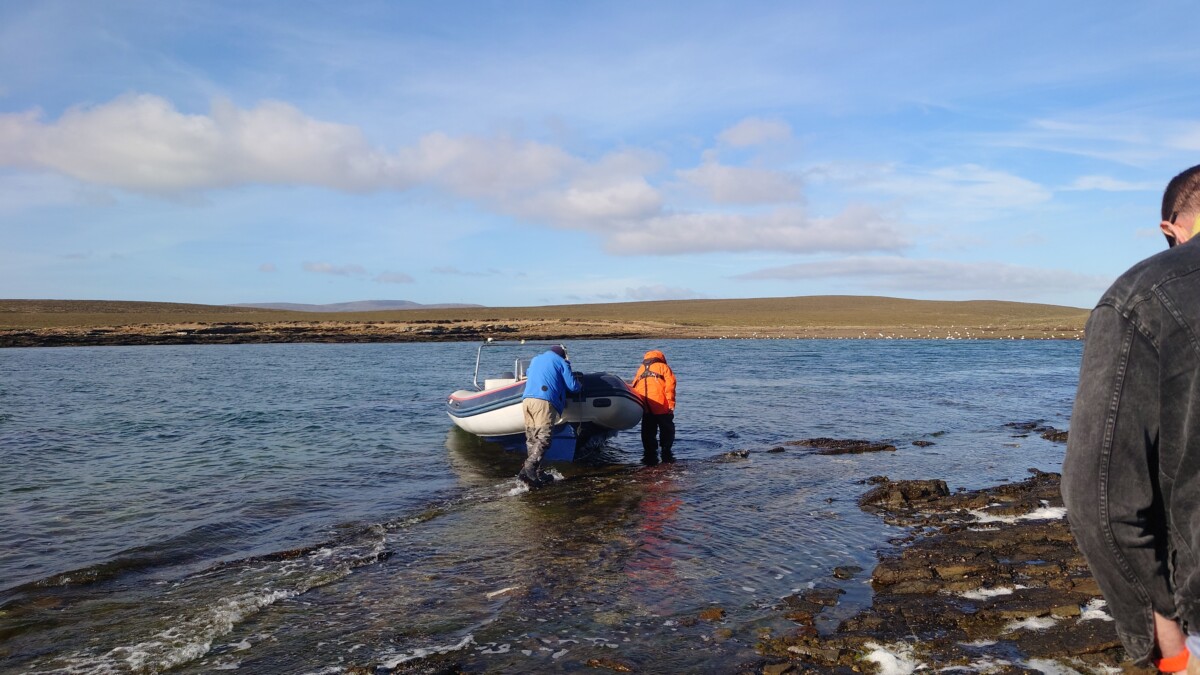
We unloaded and waited for “David” to come meet us in his rib. David duly appeared, goods and people were loaded and it was off to Keppel across the sea. 45 mins later, we were dropped off on lovely Keppel on another rocky beach.
This is how it’s done on the Falklands!
Keppel Island
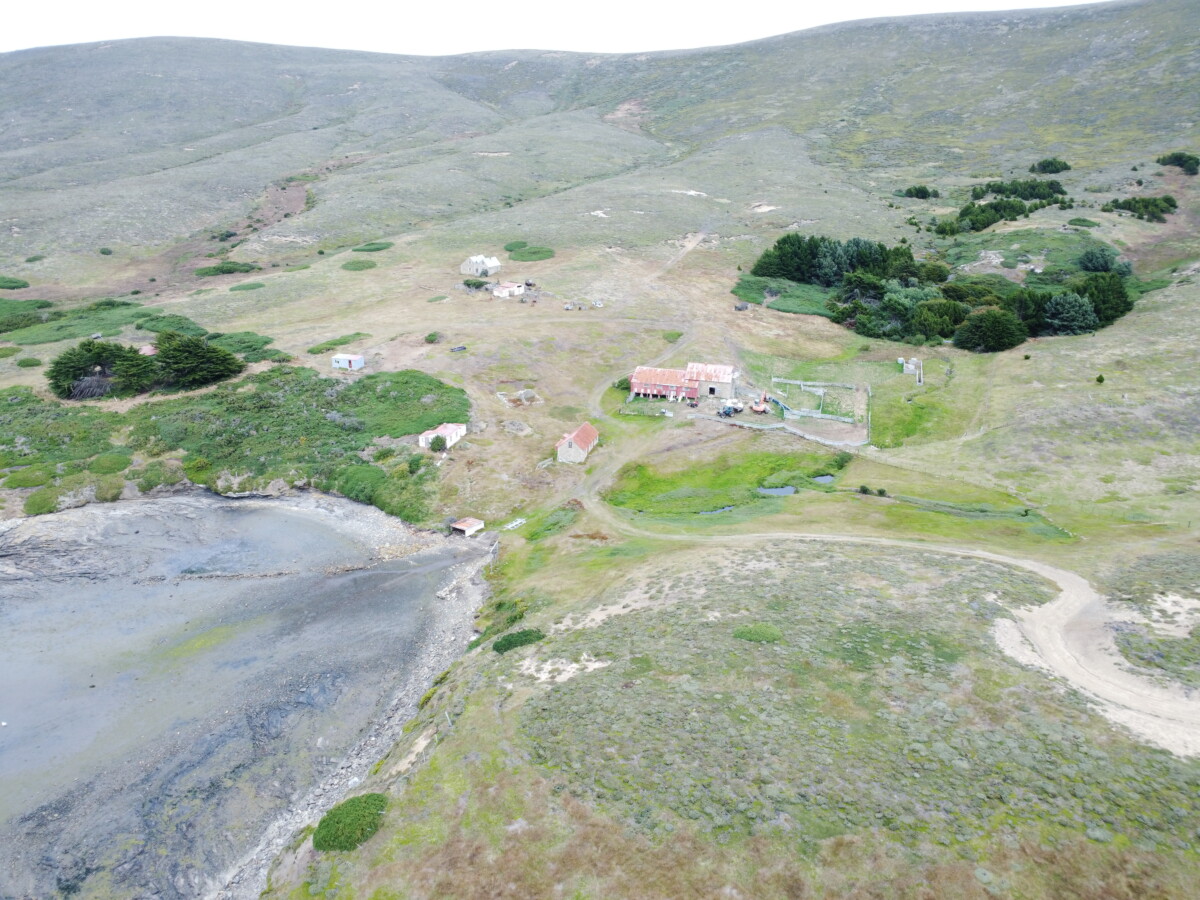
Keppel is an almost deserted island off the north west of West Falkland, sandwiched between Pebble Island to the east and Saunders to the west. In former times there was an Anglican Missionary settlement on the island and then more latterly a sheep farm. But for many years it was an unoccupied island with an amazing number of penguins and albatross on it, largely undisturbed. The settlement also boasted some of the oldest stone buildings on the Falklands. This is where Ken and I came in.
Shane has recently purchased the island and is undertaking work to save the buildings and re-establish a permanent settlement.
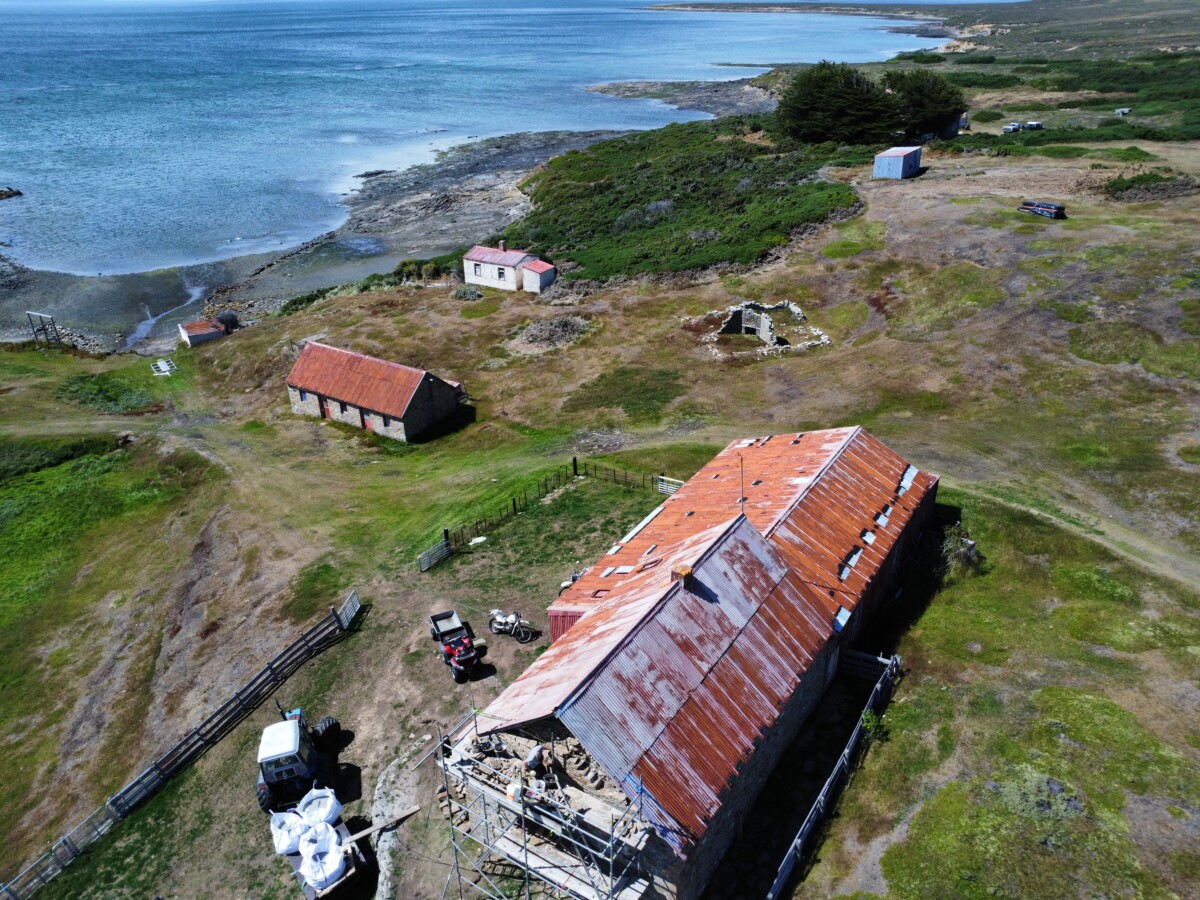
After a tour of the settlement and a look at the building works required, we decided on repairing the collapse at the top of the gable end on the sheep shearing shed. Decades of neglect had allowed rain to to penetrate the core of wall, washing out the old mud/clay mortars, leaving a void between the inner and outer skins. When combined with gaps left by old pointing falling out and decades of wind and rain doing damage, the gable end was in a sorry state.
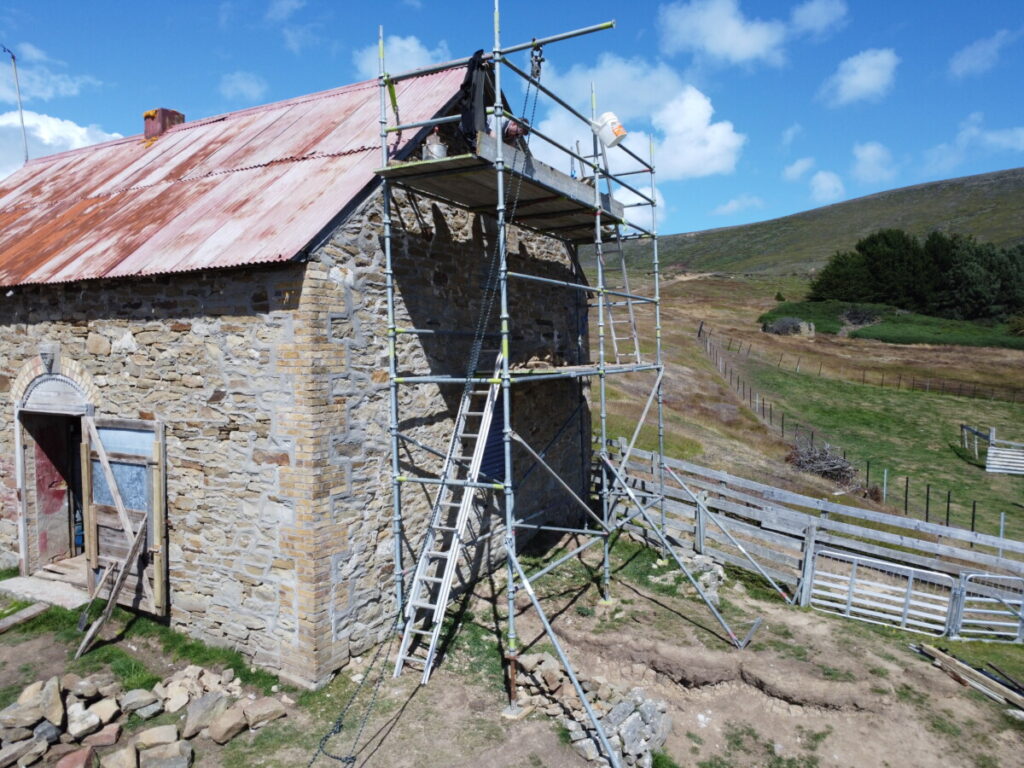
First job was to put up the scaffolding and inspect the state of the wall. The window on the first floor required a new wooden lintel, and Shane had a new one on-site. There was a bulge above the window with stone work that was still whole but leaning out, and then the hole in the outer skin.
With the scaffolding up, we set about taking down the collapse and the wall underneath down to the old lintel. It was replaced with the new timber and then the collapse was rebuilt.
Meanwhile, I set to the task of providing bucket after bucket of lime mortar mixes. We had discovered several 40kg tubs of lime putty leftover from the last repairs done 30 years previously. The amazing thing about lime mortar when stored correctly is that it will pretty much last forever. There was also 200kg of quick lime kibble that we had sent over from the UK.
We decided on a mix using the putty, sand, dried clay removed from the wall to make a strong mix for the internals of the wall. We’d use a hot lime mix for the pointing.

Five days later the gable end from the window up was rebuilt, the bulge mostly removed and the roof fixed with new barge boards, flashing and a finial. Job done.
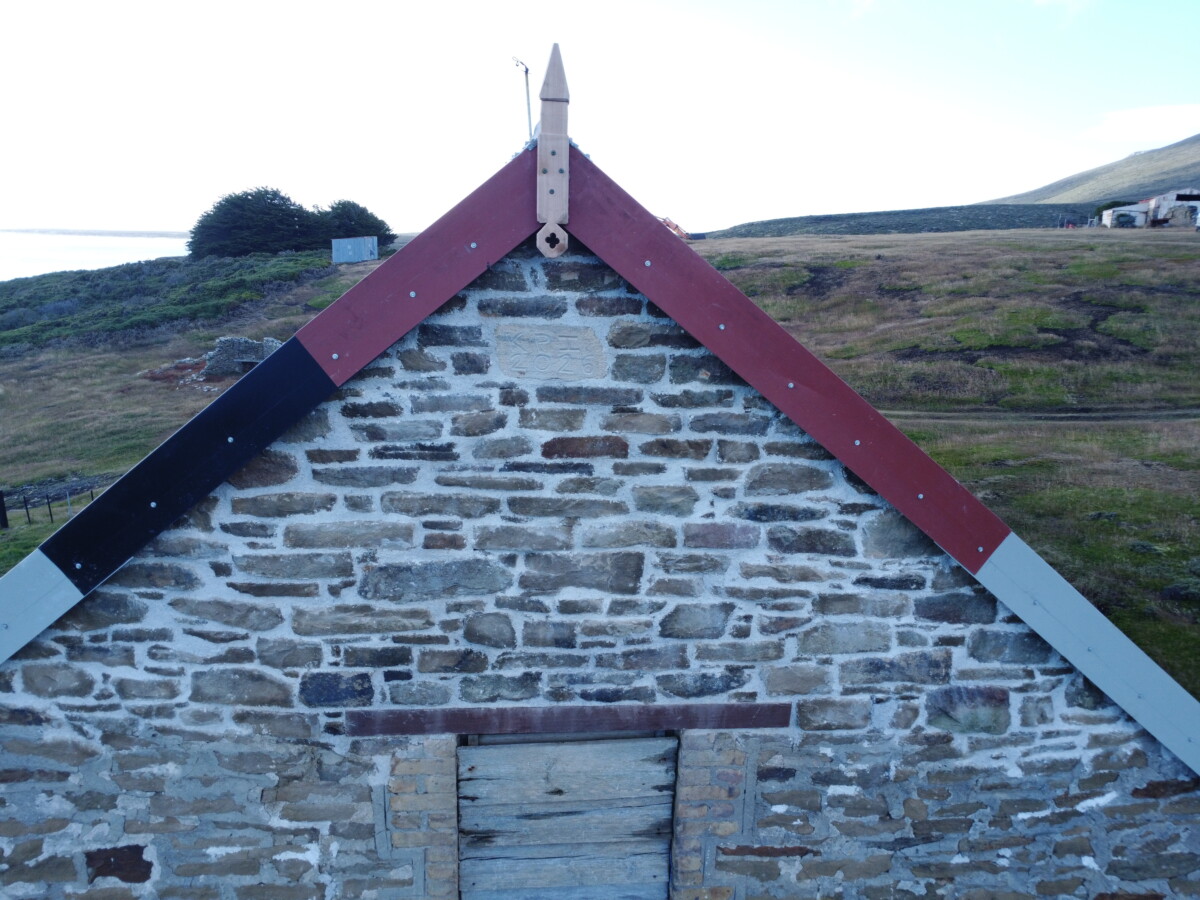
With all the building work that we had time for completed, it was time to leave. Or once we had completed a visual survey (by Ken) and an aerial survey (by drone) of the stone buildings. Partly this was to assess potential future projects and partly for a record of the state of the buildings for FIMNT.
Wildlife on Keppel
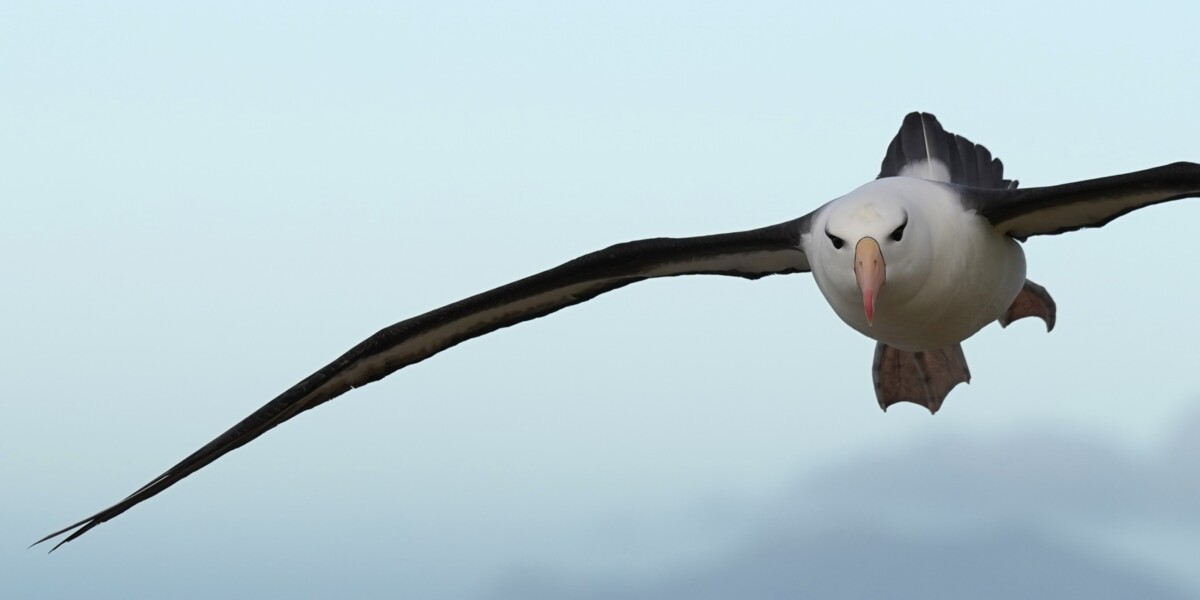
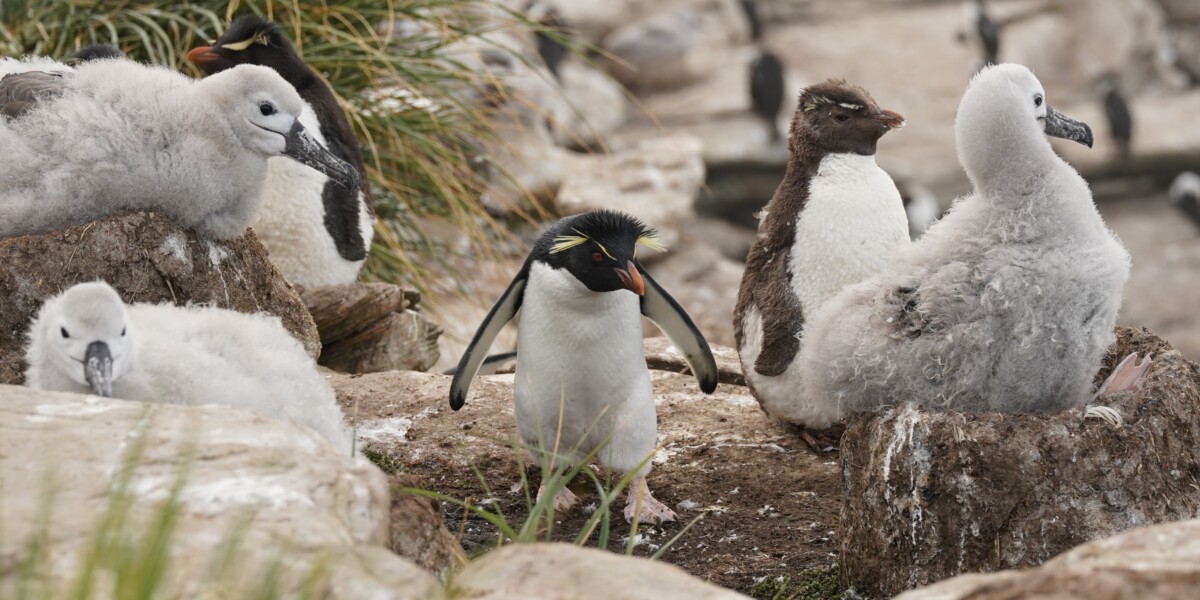
One evening Shane took Ken and I to see the fabulous Albatross and Rockhopper colony on Keppel. We spent a wonderful couple of hours watching the seabirds, listening the crashing waves and enjoying the warm evening sun.
Getting off Keppel
We were still hopeful of getting to West Point, so we left Keppel on the 15th courtesy of Dave and his rib. We headed for Saunders Island where we would take the FIGAS Islander plane on the Monday. We’d ideally end up on West Point. If the winds proved otherwise would head back to Stanley and drive down to North Arm on East Falkland on the Tuesday.
With a Sunday afternoon and evening to kill, Ken, Shane and I were taken to “The Neck”, a narrow sandy isthmus home to a large colonies of Gentoo, Megallanic and Rockhopper penguins and a small colony of Kings. A truly magical place.
James from the Settlement came with us and we had a bizarre conversation talking about his Scottish roots. So bizarre that we discovered that we not only went to the same high school, but that he was the year below me, and we must have previously crossed paths! Small world!
Unfortunately the wind was not playing ball, and so the planned work on West Point was abandoned for this trip. We flew back to Stanley on a breezy Monday, washed clothes and organised food. On the Tuesday headed down to North Arm Farm in the south part of East Falkland.
North Arm Chapel repairs
Ken and I had managed a recce trip a couple of weeks earlier. We had agreed with the trustees of the chapel on the settlement to work on repointing the north gable end and have a look at the collapsed and rebuilt section of the west wall.

We spent 10 days working on these, stripping out the old pointing, repointing the exposed joins, lime washing the brick door, took down, rebuilt and repointed 1/3 of the west wall, repointed the inside of the gable end and fixed an issue with the inside of the window on the south gable.
The quick lime sent out from the UK was used for the work, with different aggregate mixes for internal void filling, general stone building mixes, pointing mixes and a lime wash.
We also undertook a visual survey in order to produce a report on future work to be done.
North Arm settlement
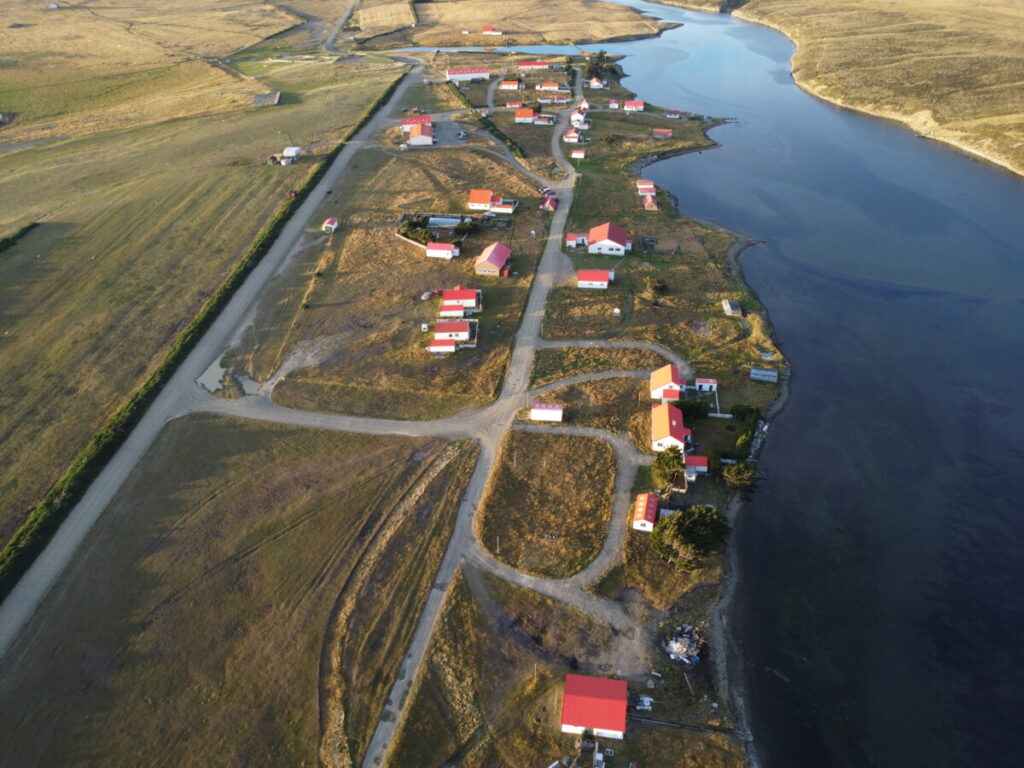
North Arm couldn’t have been more different from Keppel.
Keppel was a remote, wild and mostly people free island with some sheep and lots of wild life, especially seabirds.
North Arm by contrast was a working farm with 50000 sheep set on nearly 300000 acres of land.
The main settlement was home to a dozen permanent staff and a number of itinerant workers. Although it was linked by gravel track and road to Stanley, North Arm felt very remote from the rest of the islands.
Bull Point, North Arm
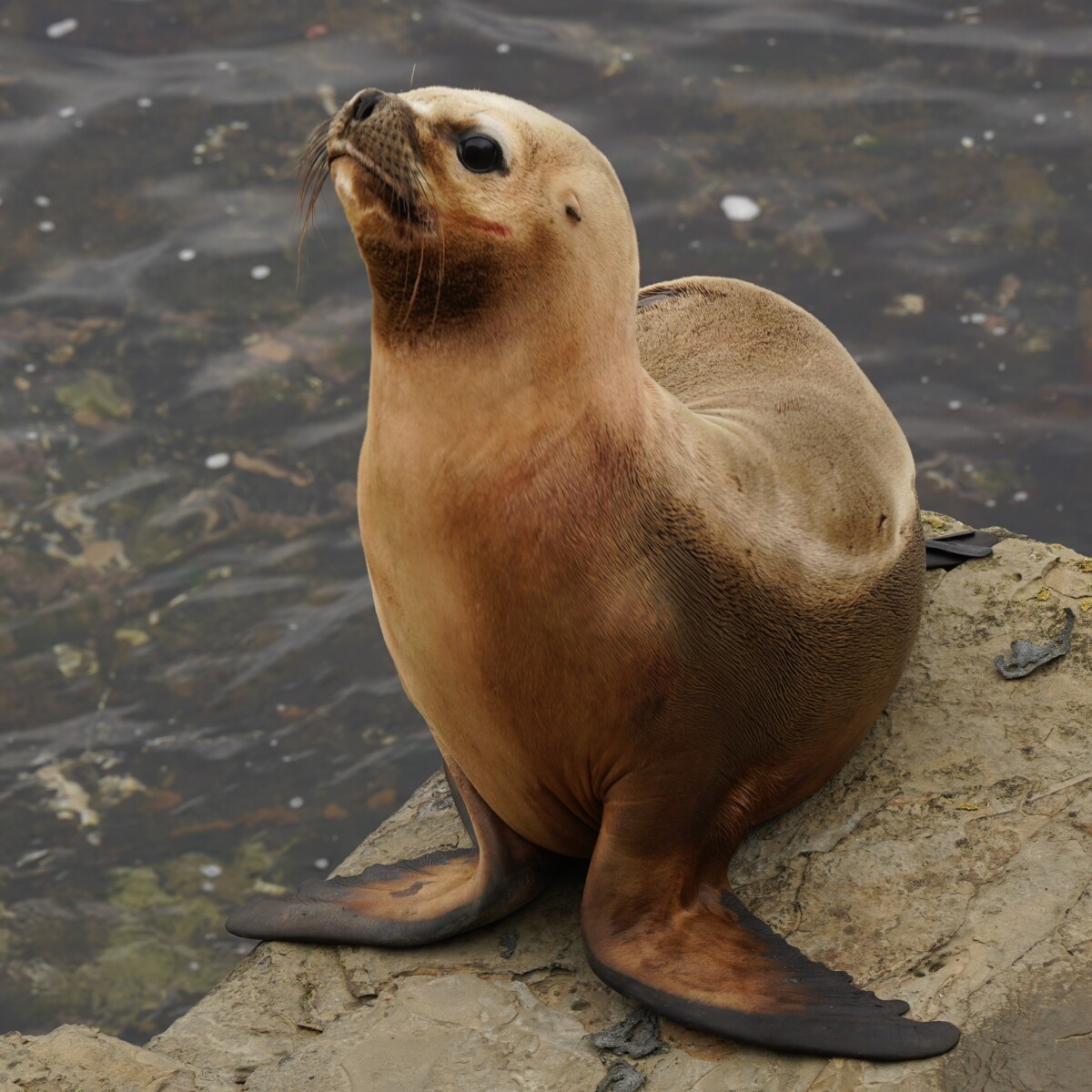
Ken and I realised how fortunate we were to be able spend a month on the islands. It enabled us to get to a couple of places well off the beaten tourist paths. There are many cruise ships that take their paying customers to fabulous places on the islands, where they are able to marvel at the wildlife and get their fill of the Penguins, Albatross, Johnny Rooks and Seals.
But virtually no tourists ever get to the seabird colonies on Keppel and even fewer people get to Bull Point. 2 1/2 hours landrover drive over tussock on the private farm at North Arm means that it is not a well frequented place.
Ian Beattie, the assistant manager at North Arm offered to drive us down to Bull Point on the Sunday. We were keen to find seals, dolphins and even whales.
Whilst we didn’t see any whales, there were plenty of Fur seals and Commerson’s dolphins.
Heading home or not.
With that phase of the work done, it was back to Stanley on the 25th. First was a debrief with Emma and James from FIMNT on the 26th. Then the long flight home to Brize Norton via Ascension on the 27th. Except the weather didn’t play ball again and the return flights were delayed by two days. Such is travelling on the Falkland Islands!
Next steps?
It’s pretty clear that there is a lot more work to do. The Chapel at North Arm requires more work on the west wall and the south gable needs repointing. The shearers shed on Keppel has some much more to do on it – weeks of repointing. And of course we never even made West Point Island to figure out what to do on the Sealers hut. And we only had a quick look at the Stables in Stanley. The old blacksmiths down by the museum is also in need of work.
So, it’s a case of expressing interest in going back and hoping that more funding can be found.